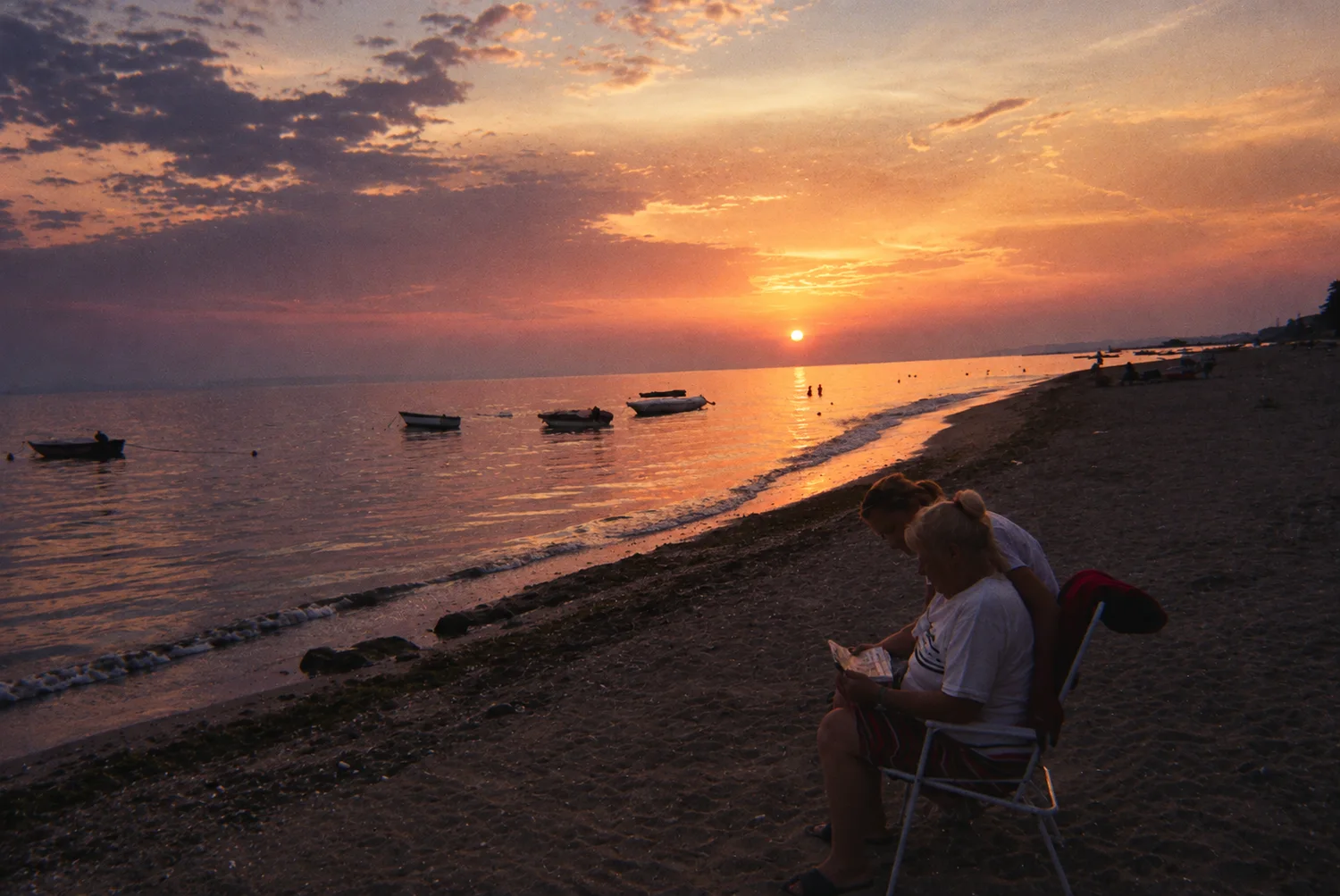
One summer as a child, wondering what lay beyond the sea, I swam past the first, second and third sandbars at Kumburgaz, a seaside town near Istanbul, and out into open water. The waves grew stronger and carried me far from the shore. I was tired, and fear took hold of me. I thought of the young people who drowned there every week, their lifeless bodies lying on the beach under sheets of newspaper. I had always been angry with myself about them: “Why couldn’t I save them?”
My small arms were exhausted, but I gathered every ounce of strength and kept swimming towards a shore that looked impossibly small. When I finally reached it, my feelings were tangled. Years have passed, yet what those drowning children may have felt has stayed in my heart.
I will come back to this small story in the middle of the essay. First, the question itself.
I grew up in Türkiye, where the Islamic language of külli irade and cüzi irade, universal will and particular will, is part of religious education and everyday conversation. I have spent much of my adult life within Sanātana Dharma, the tradition of yoga and the Bhagavad Gītā. So the question of how karma relates to divine will is not abstract for me; it is a conversation between two worlds I carry.
There is a basic difference between the concept of karma in Sanātana Dharma and the understanding of universal will in Islamic theology (kalām). Both accept a universal order, but they describe how that order works, and how much room it leaves for individual free will, in different ways. Comparing them helps us see the heart of each approach, where they meet and where they part.
Karma Is Not Fate
Karma rests on the actions a person performs and the consequences of those actions. Every action produces a reaction, and that reaction shapes our future experience. This does not mean that our lives are entirely predetermined. In Sanātana Dharma, karma is not fate: the choices we make with our free will shape our destiny.
Imagine planting a seed. Which seed we choose and how we tend it depend entirely on our will. This is an example of the karmic cycle: the result of every action is shaped by our own choices. But the growth of the seed belongs to the order of the world, to the laws of nature, to sun and rain.
In Sanātana Dharma this order is understood as the universal reality of Brahman and the cosmic order of dharma. Brahman is the source of the order, yet it is in interaction with the individual’s free will. Within this order, a human being shapes their destiny through their own actions.
Three Kinds of Karma
To understand how the tradition thinks about karma, it helps to know three distinctions:
- Sañcita karma: the total of actions accumulated over past lives that have not yet borne fruit.
- Prārabdha karma: the portion of that accumulated karma which has begun to bear fruit in this life. The family we are born into, our body and some of the circumstances of our life belong here.
- Kriyamāṇa (āgāmī) karma: the actions we perform now, with our free will, which shape the future.
Sañcita karma is the concept that sounds most abstract. Let me tell you about an experience that made it concrete for me.
Years ago a friend took me to an astrologer in India who reads from the Bhṛgu Saṃhitā. He asked for the initials of my name, then opened the book and began to read in Malayāḷam. My friend translated for me into English, but with every sentence he paused, looked at me in astonishment, and only then translated.
The astrologer began to speak about a previous life. Five hundred years ago, he said, I had been with my present Guru. I lived in the Palakkad region of Kerala and went to the Goddess temple every day to offer flowers; that, he said, is why the Goddess’s grace is with me in this life too. In Palakkad, where rivers often flood, I had drowned during a flood while saving children, at the very moment I saved the fifteenth child. That child survived. The astrologer said that this person lives near the same Guru in this life too, and that we know each other.
I share this reading not as proof, but as a story that changed the way I look at my own life. The fear I felt in the open sea as a child, the unanswered question I carried for the drowning children… The tradition calls these saṃskāra and vāsanā: the impressions and tendencies that past actions leave in the mind. Sañcita karma is exactly this accumulation. In this life, I went to Palakkad for the first time in 2017, for one of Amma’s programmes.
This is what happened in the sea that day: I had not chosen the waves that carried me out, but whether I kept swimming was in my hands.
Seen this way, the understanding of karma holds together the conditions we cannot change (prārabdha) and the choices we make at every moment (kriyamāṇa). There is neither absolute fate nor unlimited freedom; between the two lies a space of responsibility.
Universal Will and Particular Will
From the perspective of universal will (külli irade), the order of the world runs by the will of God. The sprouting of a seed, rain and sunshine are reflections of God’s will. Within this order, however, the human being acts by using their own will, the particular will (cüzi irade). Universal will grounds the whole order of the world in God’s decree, and the individual’s will is limited within that order. Human actions can produce results, but those results come about through God’s decree.
Unexpected Common Ground
At first sight the two views may seem far apart. Yet the idea of a divine will that gives the fruit of action is strongly present within the Indian tradition as well. The Brahma Sūtra (3.2.38) states that the fruit of actions comes from God (Īśvara): phalam ata upapatteḥ. The Bhagavad Gītā expresses this as advice addressed to the human being:
karmaṇy evādhikāras te mā phaleṣu kadācana
“Your right is to action alone, never to its fruits.” (Bhagavad Gītā 2.47)
Action is in our hands; the fruit is in the hands of an order greater than us. This line carries an intuition surprisingly close to the relationship between particular will and universal will.
Where They Part
In Sanātana Dharma, free will plays a strong role in interaction with the universal order and is understood within a chain of cause and effect that continues across lifetimes. In Islam, the individual’s free will acts in harmony with God’s absolute will and is understood within the responsibility of a single earthly life. This basic difference shows, alongside the contrasts, that both systems share an understanding of a universal order.
Of course, different schools within both traditions have answered these questions differently; this essay offers only a general framework. For readers of Turkish who want to explore karma and its relationship with Saturn in more depth, I discuss these themes at length in my book Karma ve Karmanın Efendisi: Satürn (Karma and the Lord of Karma: Saturn, Paloma Yayınevi, 2024).