Why Is 108 Sacred? Mālā, Mantra and the Nakṣatras
What the texts firmly support, and the beautiful interpretations added later
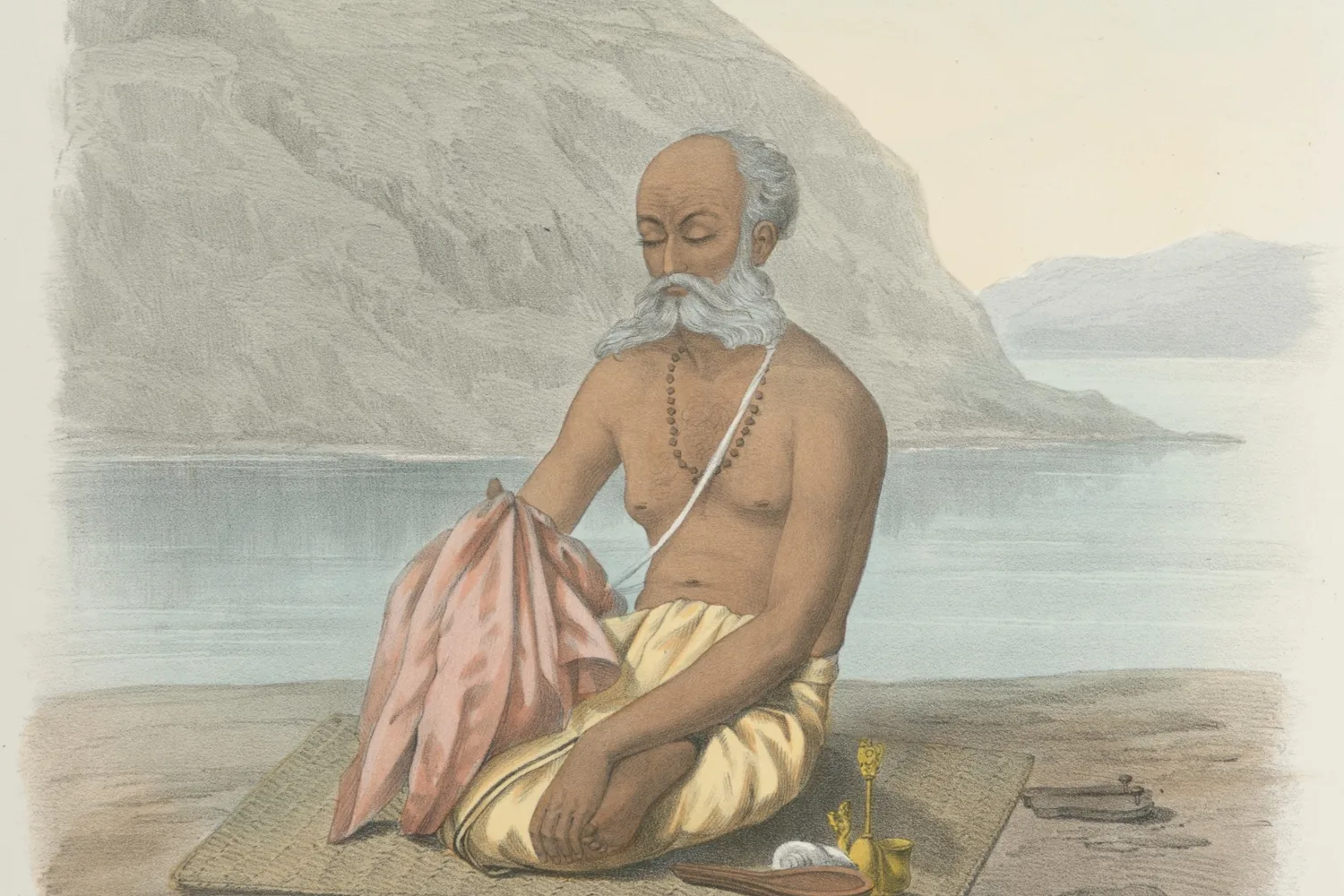
In 2018, in Amritapuri, Amma asked her children a question: what is the significance of the number 108? I gathered everything I could find and offered it to my Guru as a small piece of homework. Most of what I wrote that day had been collected from the internet.
In the years since, working closely with the texts, I have come to see that some of what is said about 108 rests on solid scriptural ground, while some of it is lovely but later interpretation. In this essay I want to separate the two and trace the number from its oldest source to the present. The sacredness of 108 does not need exaggeration.
What Does 108 Mean? The Short Answer
In Indian traditions, 108 stands for wholeness and completion: a complete circle of time, of the sky, of scripture or of a deity’s names. The mālā used for japa has 108 beads, the litanies recited for gods and goddesses contain 108 names, and mantras are often repeated 108 times. This meaning did not appear all at once; it grew from the layers we will look at below.
The Oldest Root: 10,800 in the Vedic Ritual
In the oldest sources, 108 is not yet a sacred number in its own right. It first appears as 10,800, a unit of Vedic ritual and of the calendar. The Śatapatha Brāhmaṇa makes this connection most clearly:
- The altar is the year. The great fire altar is to be built with 10,800 bricks, one for each muhūrta of the year. A year has 360 days and each day 30 muhūrtas: 360 × 30 = 10,800 (ŚB 10.4.3.20).
- The Veda is the year. In the same text, Prajāpati arranges the Ṛgveda into 12,000 bṛhatī verses, that is, 432,000 syllables. This equals 10,800 lines of 40 syllables. The three Vedas together come to 864,000 syllables (ŚB 10.4.2.23–25).
- The breath is the year. In a passage that identifies the year with the human being, the text says that a person breathes in and out “a hundred hundred and eight hundred” times in a day and a night, that is, 10,800 times: the same number as the muhūrtas of the year (ŚB 12.3.2.8).
- Why this number? The Indologist Luis González-Reimann traces it to sexagesimal reckoning: an ideal year of 360 days and a circle of 360 degrees. Half the circle is 180 degrees × 60 minutes = 10,800.
Notice something here: 432,000 is also the length of the Kali Yuga, and 864,000 that of the Dvāpara Yuga. The later Purāṇic reckoning of the yugas inherits this Vedic family of numbers, and every yuga is an exact multiple of 108 (432,000 = 108 × 4,000).
The Brāhmaṇa never says “108 is sacred.” But it brings time, sound, altar and body together in one number, and the later reverence for 108 inherits this correspondence.
The Sky: 108 Divisions in Jyotiṣa
- 27 nakṣatras × 4 pādas = 108. Each of the 27 lunar mansions is divided into four quarters (pādas).
- 12 signs × 9 navāṃśas = 108. Each sign is divided into nine, and the navāṃśa (D9) chart rests on this division (Bṛhat Parāśara Horā Śāstra). Every nakṣatra pāda corresponds exactly to one navāṃśa, so the lunar and solar grids of the sky meet at 108.
- The often heard “12 signs × 9 planets = 108” is numerically correct, but it rests on a weaker technical basis than the first two.
Sacred Texts and Sacred Geography
- 108 Upaniṣads. In the Muktikā Upaniṣad, Rāma teaches Hanumān a graded path: the Māṇḍūkya alone is enough; failing that, ten Upaniṣads, then thirty-two, and for liberation free of the body, all 108. Centuries separate the texts on this list, and many more texts bear the name Upaniṣad. Here 108 is not a historical count but a number that declares completeness.
- [108 Divya Deśams](https://en.wikipedia.org/wiki/Divya_Desam). The 108 Viṣṇu shrines sanctified by the hymns of the Tamil Āḻvār poets. The last two, the Ocean of Milk and Vaikuṇṭha, are not on earth but in the heavens, so the list joins the earthly and the transcendent in a single circle.
- 108 Śākta pīṭhas. The Devī Bhāgavata Purāṇa lists 108 seats of the Goddess. The historian D. C. Sircar, in his 1948 study, shows how such lists grew over time: 7, 10, 18, then 42, 50, 51 and finally 108. By the medieval period, 108 was no longer a total arrived at by counting but a target a list was built to reach.
- Kṛṣṇa’s wives. The princesses Kṛṣṇa rescues from Narakāsura number 16,000 in the Bhāgavata and the Mahābhārata, and 16,100 in the Viṣṇu Purāṇa and the Harivaṃśa (overview). With the eight principal queens, tradition often remembers the total as 16,108.
108 in Practice: Mālā, Breath and the 108 Names
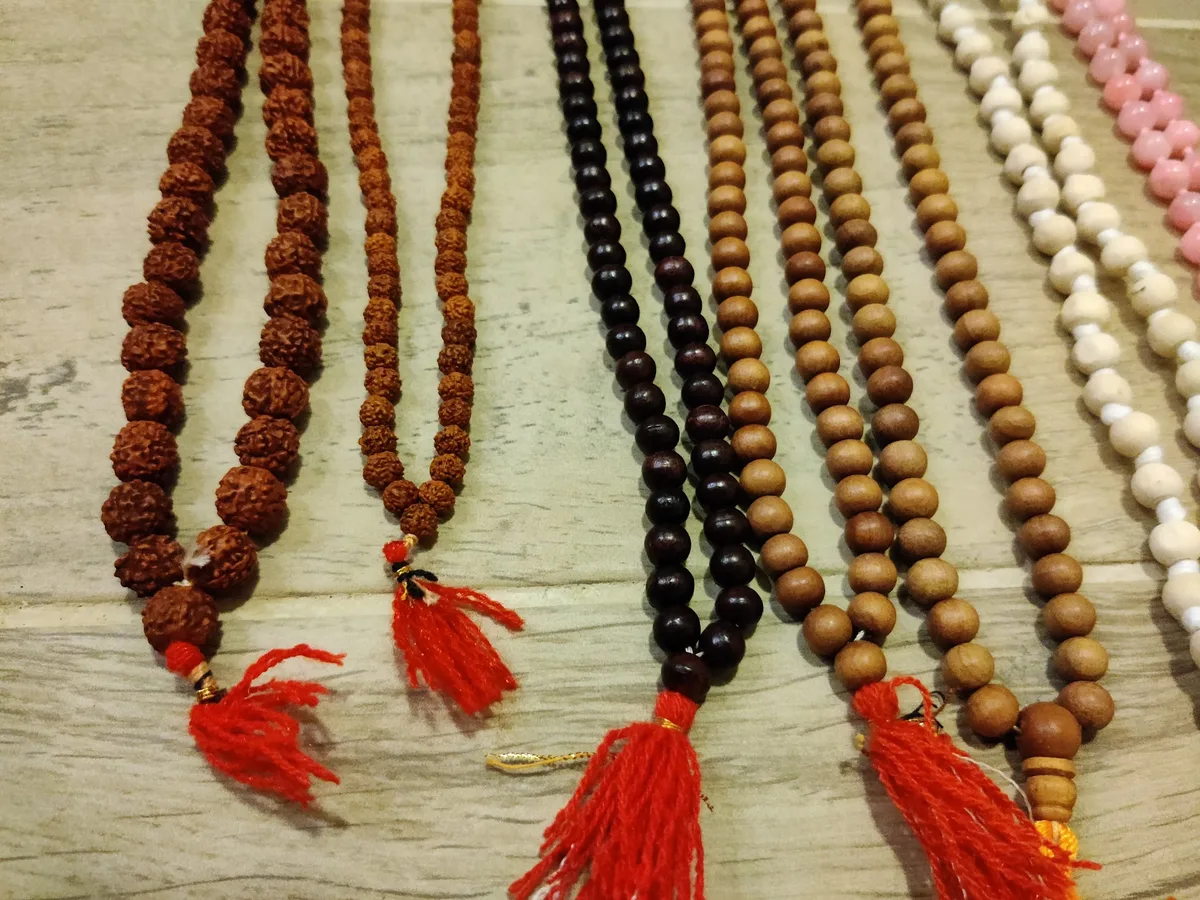
In japa, the 108 beads of the mālā pass one by one through the fingers. The 109th, larger bead is called the meru or guru bead and is not counted. In many traditions one does not cross over the meru at the end of a round; the mālā is turned and the count continues in the other direction. Even this small rule teaches something: when we reach the summit, we do not claim it; we turn back with reverence. In mantra manuals, 108, 1,008 and 10,008 are standard counts.
The link between breath and 108 also goes back to the Vedic root. The 10,800 breaths of the Śatapatha Brāhmaṇa become 21,600 in the later yoga Upaniṣads, where each inhalation and exhalation is a spontaneous “haṃsa” mantra. Half of that is again 10,800, or 108 × 100. That is about 15 breaths a minute, a reasonable figure for an adult at rest.
Nearly every god and goddess has a litany of 108 names, an aṣṭottaraśata-nāmāvalī, and so do gurus: Amma’s 108 names, the Śrī Mātā Amṛtānandamayī Aṣṭottaraśata Nāmāvalī, are recited every day around the world. To call upon a being with 108 names is to honour them as complete, like a full year, a full sky and a full canon.
Dance and Sister Traditions
- Nāṭyaśāstra. Chapter 4 of Bharata’s treatise on dance and drama describes 108 karaṇas, units of movement attributed to Śiva’s tāṇḍava. They are carved one by one on the temples of Thanjavur, Kumbakonam and Chidambaram, and dancers today reconstruct them from these reliefs.
- Jainism. The attributes of the five supreme beings (Pañca Parameṣṭhin) add up to 108: Arihanta 12, Siddha 8, Ācārya 36, Upādhyāya 25, Sādhu 27. This is why the Jain mālā has 108 beads. The Śvetāmbara and Digambara traditions itemise some attributes differently, but both arrive at 108.
- Buddhism. Japanese Buddhism speaks of 108 afflictions of the mind (bonnō, Sanskrit kleśa). One common explanation is 36 passions experienced in the past, present and future (36 × 3), though explanations vary. The Japanese custom of ringing temple bells 108 times at the turn of the year comes from this. Incidentally, my own name, Sugata, is one of the names of the Buddha.
108 in the Sky: How Much of It Is True?
The average distance between the Sun and the Earth is about 107.5 times the Sun’s diameter, varying between 105.6 and 109.2 over the year (NASA). The Sun’s diameter is about 109 times the Earth’s. The average distance between the Earth and the Moon is about 110 times the Moon’s diameter, varying between 104 and 117 (NASA).
These ratios are remarkably close to 108, but they are not exactly 108. That the ancient sages knew them is a hypothesis put forward by some authors, such as Subhash Kak, not an established fact. It is more honest to read them as a lovely closeness than as “science proving 108.”
There are mathematical beauties too. 108 is a Harshad number: it is divisible by the sum of its digits (9). The Indian mathematician D. R. Kaprekar coined the term in the twentieth century from the Sanskrit harṣa-da, “joy-giving.” The interior angle of a regular pentagon is 108 degrees, and 108 can be written as 1¹ × 2² × 3³. True arithmetic, but not a scriptural argument.
Beautiful but Unsourced
You will often meet the following claims online. I could not find a classical source for them, or the sources give different numbers:
- 108 marma points: the Suśruta Saṃhitā (Śārīrasthāna 6) counts 107. Adding the mind or the heart as the 108th is a later interpretation.
- 108 nāḍīs converging at the heart cakra: no classical source is known. The early Upaniṣads speak of 101 channels of the heart (Kaṭha 6.16, Chāndogya 8.6.6, Praśna 3.6; trans. P. Olivelle, *The Early Upaniṣads*).
- A Sanskrit alphabet of 54 letters, each with a Śiva and a Śakti aspect, making 108: the number of letters varies by tradition; as mātṛkā, 50 letters are most often counted.
- 54 intersections in the Śrī Yantra: a late or popular interpretation; the drawing and the method of counting differ between traditions.
- 108 types of meditation, enlightenment through only 108 breaths a day, or a Ganges that spans 12 degrees of longitude × 9 of latitude: none has a classical basis. The Ganges in fact spans about 10 degrees of longitude.
- 108 repetitions giving “one hundred per cent benefit” from japa: no such calculation appears in the scriptures.
These are not things to throw away as simply wrong. But they show how a tradition multiplies its own symbols. Knowing what comes from the texts and what comes from interpretation is simply a matter of respect for the reader.
What 108 Means to Me
When I prepared that homework, I was chasing numbers. Over the years I have come to think that what 108 really taught me is repetition itself. To repeat the same name 108 times is to call the scattered mind back 108 times. This is what the Yoga Sūtras call abhyāsa, practice sustained with patience. Each brick of the Vedic altar is a moment, each bead of the mālā a breath. That is also why 108 stands in the name of this site and of my Instagram account: a reminder to begin again, every day.
Frequently Asked Questions
What does 108 mean? It is a sacred number of wholeness in the Hindu, Buddhist and Jain traditions. Its roots reach back to the Vedic calendrical unit of 10,800, and it appears in the beads of the mālā, in mantra repetitions, in litanies of 108 names and in the 108 pādas of the nakṣatras in jyotiṣa.
Why are mantras chanted 108 times? One full round of a mālā is 108 repetitions. Because the number is the tradition’s symbol of wholeness, one round counts as a complete practice.
What are 108 Sun Salutations? Some yoga studios practise 108 Sūrya Namaskāras at the equinoxes and solstices. This is a custom of modern yoga practice, not of the classical texts.
Sources
- Śatapatha Brāhmaṇa, trans. J. Eggeling, Sacred Books of the East 43–44: 10.4.2, 10.4.3.20, 12.3.2
- L. González-Reimann, Tiempo cíclico y eras del mundo en la India (1988); his note on the INDOLOGY list
- D. C. Sircar, The Śākta Pīṭhas (1948); summaries by Bibek Debroy: The Spirit of the Mother Goddess, Exploring the Shakti Peethas
- Muktikā Upaniṣad · 108 Divya Deśams · Kṛṣṇa’s wives
- Bharata, Nāṭyaśāstra 4; A. Lopez y Royo, “Issues in Dance Reconstruction”, Dance Research Journal (2004); K. Vatsyayan, The 108 Karaṇas (Sangeet Natak Akademi, 1966)
- 108 Attributes of the Five Supreme Beings, Jain Education International · Joya no kane, bells.org
- Suśruta Saṃhitā, Śārīrasthāna 6: Marma, Caraka Saṃhitā Online
- Kaṭha Upaniṣad 6.16, Chāndogya Upaniṣad 8.6.6, Praśna Upaniṣad 3.6: P. Olivelle, The Early Upaniṣads: Annotated Text and Translation (Oxford University Press, 1998)
- Bhāgavata Purāṇa 3.11 (durations of the yugas), trans. B. Debroy · Bṛhat Parāśara Horā Śāstra
- NASA, Planetary Fact Sheets: Sun, Moon · S. Kak, INDOLOGY list, 1993