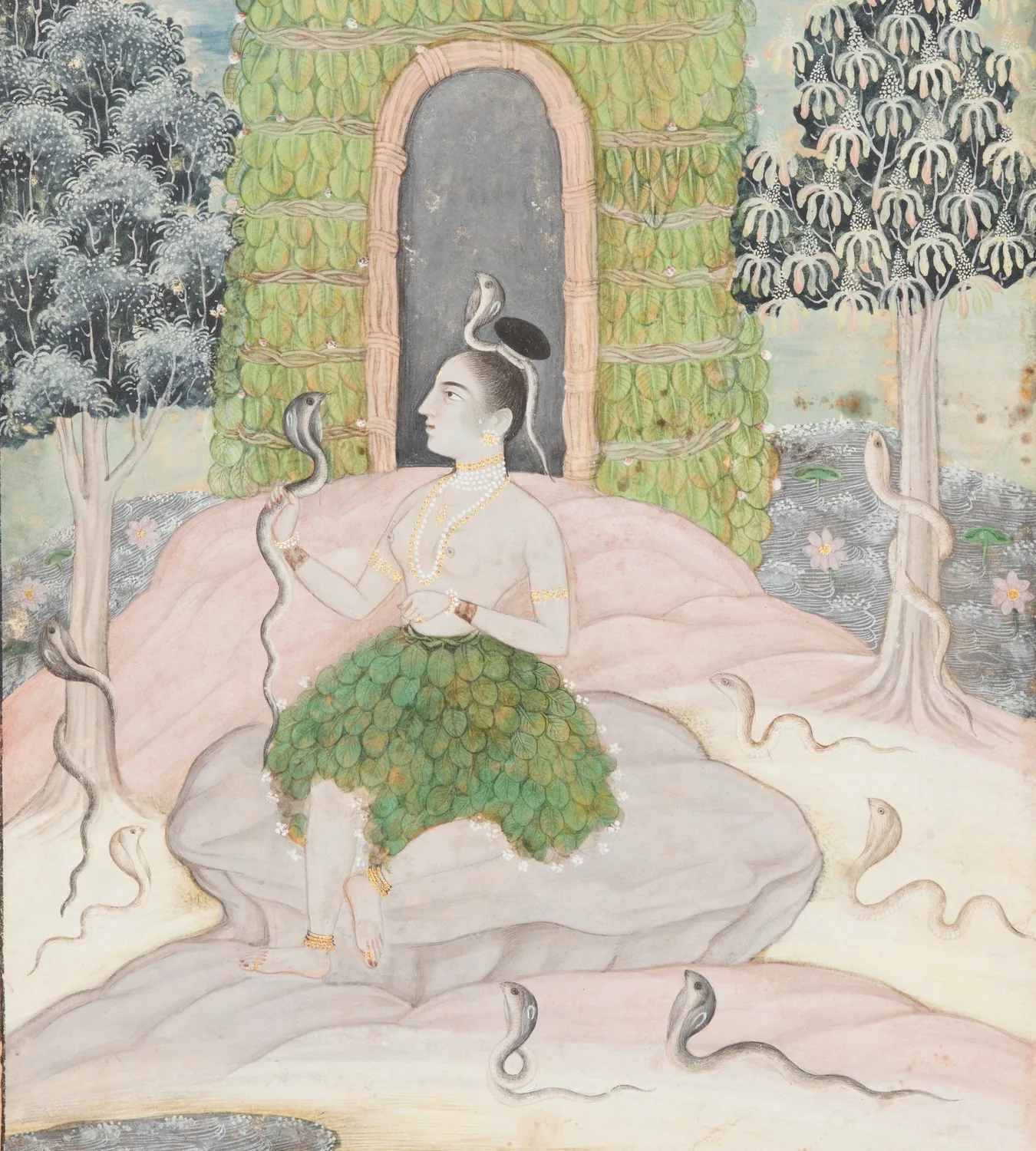
You have just finished an hour of yoga. Your body has softened, your breath has slowed, your mind has settled. You roll up your mat and step back into your day. Then someone cuts you off in traffic, a person close to you criticises you, or the news you were waiting for does not arrive. What is left of the calm you felt a moment ago?
Perhaps this is exactly where the real practice of yoga begins.
When we hear the word yoga today, most of us think of postures (āsana), breathing practices (prāṇāyāma) and meditation. Yet on the eightfold path that the sage Patañjali describes in the Yoga Sūtra (aṣṭāṅga yoga, YS II.29), āsana comes only third. The first two steps are yama and niyama.
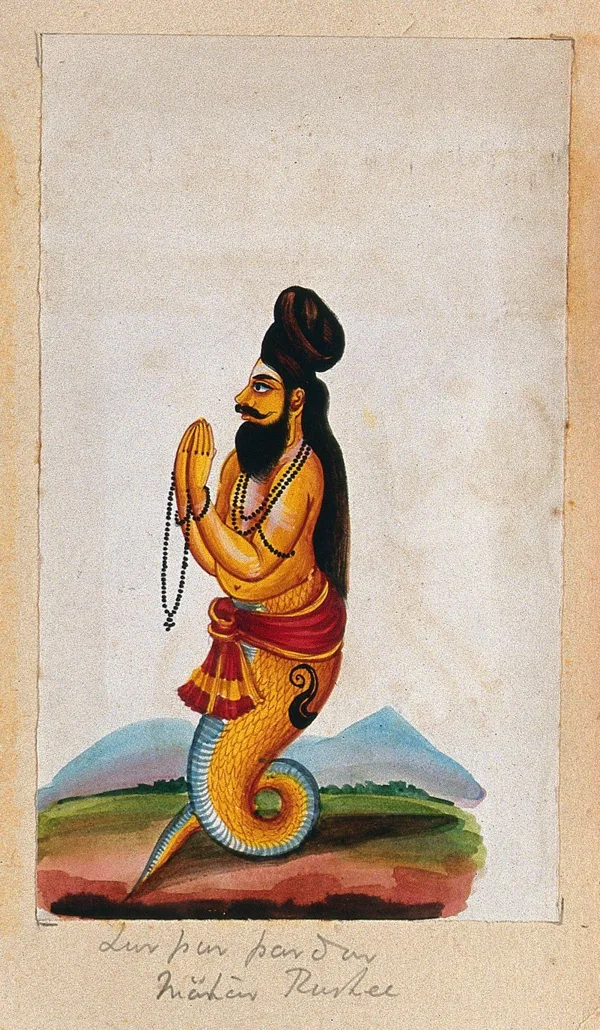
If we keep in mind that Patañjali defines yoga as yogaś citta-vṛtti-nirodhaḥ (YS I.2), the stilling of the fluctuations of the mind, this order hardly seems accidental. A person who wants to quiet the mind must first look at the relationship they have built with themselves and with the world. While we harm other beings, tell lies, or live with envy and greed, what is it but a foolish dream to expect the mind to find peace?
Yama and niyama are an answer to precisely this question.
Yama: Five principles for our relationship with the world
In the second chapter of his work, known as the Sādhana Pāda, Patañjali lists the five yamas:
ahiṃsā-satyāsteya-brahmacaryāparigrahā yamāḥ (YS II.30)
Non-violence, truthfulness, non-stealing, brahmacarya and non-possessiveness are the yamas.
The yamas are ethical principles that shape how we relate to others and to the world around us. In the next sūtra (II.31), Patañjali calls them the great vow (mahāvrata), unconditioned by birth, place, time or circumstance.
In other words, these principles do not apply only on the meditation cushion, in the temple or in the ashram. They apply at home, at work, on the street, and above all in the moments when no one is watching.
Ahiṃsā: Not harming is more than not striking
Ahiṃsā is usually translated as non-violence. Yet refraining from physical violence is only its most visible dimension.
In his commentary on YS II.30, Vyāsa explains ahiṃsā as not harming any living being, in any way, at any time. He even adds that the other yamas exist to serve and protect ahiṃsā.
What if we never harm someone physically, yet wound them with our words? Or if, without saying anything at all, we nurse anger and hostility towards them in our thoughts?
In Indian thought, moral action is not limited to the body. Thought, speech and deed are considered together. This threefold understanding also offers a strong framework for bringing ahiṃsā into our lives.
In Anatolian wisdom, a saying attributed to Haji Bektash Veli, the thirteenth-century Anatolian Sufi saint, comes to mind: “Be master of your hand, your tongue and your loins.” It is a principle of conduct well known in the Bektashi tradition.
Ahiṃsā asks us not only to refrain from harming others, but also to notice the anger and fear behind our reactions.
Satya: Must every truth be spoken?
Satya is truthfulness and devotion to truth. At first sight it seems simple. We will not lie. But what if something true we say needlessly wounds the other person?
In Vyāsa’s commentary, truthful speech must correspond to reality and also serve the welfare of living beings. Speaking the truth should not become an excuse for hurting someone.
The Manu Smṛti offers a similar counsel:
“Speak the truth, speak what is pleasing. Do not speak an unpleasant truth, and do not speak a pleasing untruth. This is the eternal dharma.” (IV.138)
Of course, this does not mean we should always hide uncomfortable truths. Sometimes the truth must be spoken even at the cost of upsetting someone. But how, when and with what intention we say it matters.
In an argument, do we want to be right, or do we truly want to understand and be understood?
Satya invites us to question not only whether our words are true, but also the intention behind them.
Asteya: Are we sure we do not steal?
Asteya means not taking what belongs to another without permission. But if we limit stealing to material things, we may miss how far this principle reaches into daily life.
If we are always late to meetings, we are taking someone else’s time. If we interrupt a friend, we are limiting their opportunity to express themselves. If we present another person’s idea as our own, we are claiming their labour.
All of these are examples of how asteya can be applied to contemporary life.
Why, then, do we want what is not ours?
Sometimes a feeling of insufficiency lies behind it: “I do not have enough. I am not good enough. If I had what they have, I would be complete.”
Seen this way, asteya invites us not only to refrain from stealing, but also to face the sense of lack within ourselves.
Brahmacarya: Keeping inner freedom while living in the world
Brahmacarya is perhaps the most misunderstood of all the yamas and niyamas.
In classical yoga commentaries it is mostly explained as sexual abstinence and the restraint of sexual energy. In this sense it is an important discipline, especially within the traditional ascetic life.
The word, however, has a wider range of meanings and associations. Brahman is the Absolute Reality; carya relates to conduct, way of life, or following a path. Brahmacarya thus also suggests the idea of orienting one’s whole life towards the highest truth.
How, then, can someone who has a family, works, raises children or carries everyday responsibilities live this path?
As my Guru, Amma (Mata Amritanandamayi), also emphasises in her teachings, one does not have to leave family life to live spiritually. While fulfilling one’s responsibilities in the outer world, one can live inwardly without being bound to one’s roles, that is, without clinging to what one has and what one goes through. Amma reminds us that true renunciation is not only giving things up in the outer world, but the mind becoming free of its attachment to them.
So the question is not only what we do, but how we are bound to what we do.
Can we live in the world without being wholly captured by it?
Aparigraha: Do our possessions possess us?
When we buy something new, we often feel a brief happiness. Then we have to protect it, store it, clean it and, when needed, have it repaired. And when we lose it one day, we grieve.
Sometimes owning something is, without our noticing, taking on a new burden.
Aparigraha is the principle of non-possessiveness, non-accumulation and non-clinging. Parigraha means acquiring or taking possession of something, and the initial a makes it a negation.
Swami Hariharānanda Āraṇya draws attention to the troubles that come with owning, with protecting what we own, and with losing it.
Aparigraha should not be understood as a call that requires us to leave everything behind. It can also help us see the difference between need and desire in daily life.
Clothes in the wardrobe we never wear, books on the shelf we never read, grievances we have carried in the mind for years…
Are we not hoarding all of them?
Perhaps the heaviest load we need to set down is not our material things, but our attachment to the past and to our own expectations.
The lighter the load, the easier the journey.
Niyama: Five principles for our relationship with ourselves
While the yamas show how we should act towards others and the world, the niyamas turn our attention to our inner world.
Patañjali says:
śauca-santoṣa-tapaḥ-svādhyāyeśvara-praṇidhānāni niyamāḥ (YS II.32)
Cleanliness, contentment, tapas, svādhyāya and devotion to Īśvara are the niyamas.
Yama and niyama are not two separate disciplines. How we treat others affects our inner world, and what we nourish in our inner world shows itself in our behaviour.
Śauca: Does cleanliness belong only to the body?
Śauca means purity and cleanliness.
Vyāsa divides it into outer and inner cleanliness. Outer cleanliness concerns bodily hygiene. Inner cleanliness involves purifying the mind of envy, pride, anger and similar impurities.
If outer cleanliness were enough, all the ducks and fish would have reached enlightenment long ago, wouldn’t they?
Yet however often a person bathes, the mind can still be full of envy or hatred.
This is the harder side of śauca. Of the time we give to cleaning the body, how much do we give to observing the mind?
Santoṣa: Can we be at peace even when things do not go our way?
We are happy when someone praises us. We rejoice when we achieve a long-awaited goal. We are excited when we buy something new.
Yet these feelings rarely last. One wish is fulfilled, and another appears.
Santoṣa, contentment, is different from these passing joys.
It is the ability to cultivate inner satisfaction while knowing that circumstances will not always be as we wish.
According to Patañjali:
santoṣād anuttamaḥ sukha-lābhaḥ (YS II.42)
“From contentment, unsurpassed happiness is gained.”
There is an important distinction here: contentment is not passivity, nor bowing to injustice. We can keep our inner contentment while working to change the problems in our lives.
Wanting things to be better and constantly rejecting where we are now are not the same thing.
Perhaps true contentment is not to stop striving in life, but to stop quarrelling with it.
Tapas: The fire that transforms us
The Sanskrit root √tap is related to heating and burning.
Tapas carries the meanings of self-discipline, austerity and transformative effort. When a person wants to transform their habits, they often have to pass through certain difficulties.
Think of the disciplined life an athlete leads before a competition. Going to bed early, eating regularly, training, and at times giving up pleasant habits…
These, too, can help us understand tapas in everyday life.
Yet tapas is not self-torment. The aim is not to suffer, but to master the habits that keep us from our goals.
The Bhagavad Gītā treats tapas on three levels: body, speech and mind (17.14 to 17.16). Discipline thus ceases to be merely physical effort and extends to our speech, our thoughts and our intentions.
The saying attributed to the thirteenth-century Sufi poet Rūmī, “I was raw, I was cooked, I was burned”, is a beautiful summary of this path.
Transformation is not always comfortable. Sometimes we need to light a fire within ourselves to move beyond the limits of the self we are used to.
Svādhyāya: In which mirror do we see ourselves?
The Sanskrit word svādhyāya is formed from sva (one’s own) and adhyāya, which carries the meanings of lesson, chapter, reading or recitation. In its traditional sense, svādhyāya is the reading and recitation of one’s own sacred text. Yet the “self” meant here is not merely our personality or our psychological ego.
Vyāsa defines svādhyāya as the repetition of mantra (japa) and the study of the sacred texts that lead to liberation. Why, then, do we read the ancient texts?
Only to accumulate knowledge, memorise Sanskrit terms or pass them on to others? Or to find what the words we read mean in our own lives?
I find this second aspect of svādhyāya especially valuable. The ancient texts do not only give us knowledge from outside; they also hold up a mirror in which we can look at ourselves. While reflecting on a text, we may meet a fear, a habit or a prejudice we had not noticed before. We may even realise how much of what we take to be ourselves is conditioning carried over from the past.
In this way, the study of sacred texts also opens a door to exploring our own inner world. This is not a literal rendering of Vyāsa’s traditional definition, but a practice of self-inquiry we can develop as we carry svādhyāya into the life of today.
As Kṛṣṇa says in the Bhagavad Gītā:
“In this world there is nothing as purifying as knowledge.” (BG 4.38)
What is meant here, however, is not only intellectual knowledge. It is knowledge that ripens in a person’s life, is tested through experience, and ultimately leads to deeper self-knowledge.
If what we read does not change us, have we truly learned it?
Īśvara-praṇidhāna: Can we let go of the need for control with humility?
The human mind loves control.
We want to plan the future, calculate outcomes and remove uncertainty. Yet life does not always follow our plans.
Īśvara-praṇidhāna invites us to question this desire for control.
In Patañjali’s system, Īśvara is defined as a distinct puruṣa (puruṣa-viśeṣa), or principle of consciousness (YS I.24). Praṇidhāna carries the meanings of turning towards, dedication and surrender.
Patañjali returns to this principle again and again. He presents devotion to Īśvara as one of the paths to samādhi (I.23), counts it among the elements of Kriyā Yoga (II.1), and names it as the last of the niyamas (II.32). He even goes one step further:
samādhi-siddhir īśvara-praṇidhānāt (YS II.45)
“From devotion to Īśvara comes perfection in samādhi.”
When we regard yoga philosophy only as physical exercise or a technique for mental relaxation, this dimension is easily overlooked.
In the classical yoga tradition, however, devotion to the Divine has a clear place. At the same time, yoga is not a system that requires belonging to a particular institutional religion. Nor should Patañjali’s concept of Īśvara be equated one to one with the idea of God in any particular religion.
What, then, does surrender mean? Leaving everything to chance, running from our responsibilities, or resigning ourselves to fate?
Of course not.
Surrender is accepting, after we have done our best, that we cannot control the outcome entirely. It is not giving up effort, but becoming free of our dependence on the fruit of our effort.
Perhaps one of the greatest freedoms a person can have is letting go of the thought that everything must happen as they wish.
Nālāgiri: The elephant that bowed before compassion
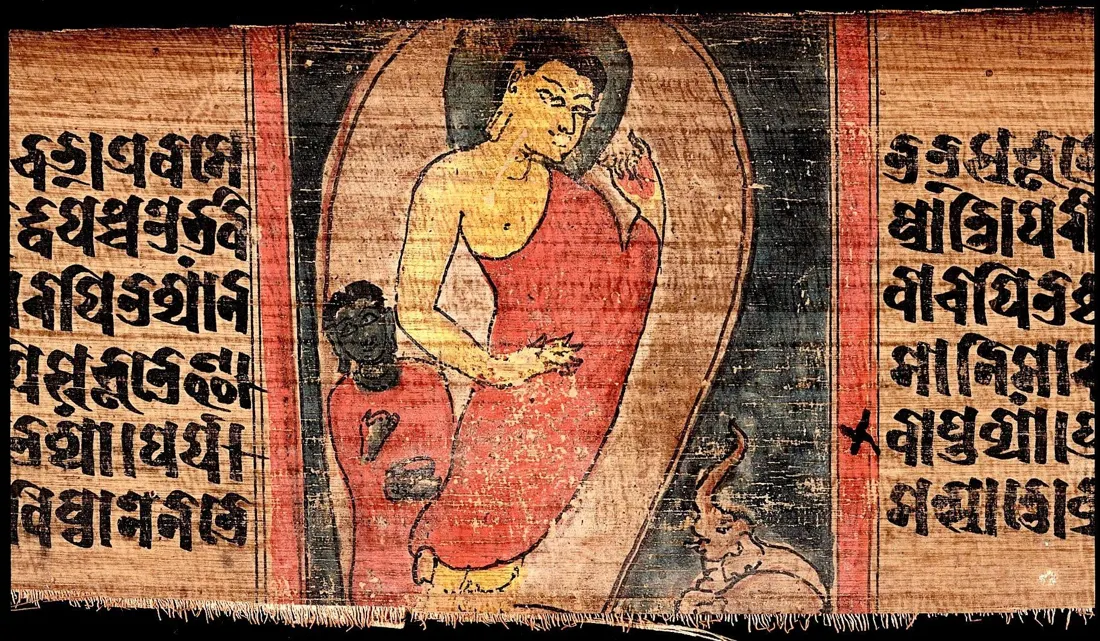
As the Buddhist tradition tells it, one day, as the Buddha walks through the streets of Rājagṛha with his disciples, chaos suddenly breaks out. People run in every direction in fear. Coming towards them is a giant elephant, ready to crush everything in its path.
Its name is Nālāgiri.
Devadatta, the Buddha’s enemy, has let this enraged elephant loose to kill him. As Nālāgiri advances, the disciples urge the Buddha to step aside. But the Buddha does not turn from his path.
He neither tries to flee nor uses force to stop the elephant. Instead, he cultivates boundless loving-kindness and compassion (mettā) towards it in his heart.
Nālāgiri comes closer and closer. Just as everyone expects the elephant to trample the Buddha, something unexpected happens.
The giant animal that was charging in fury a moment ago stops before the Buddha. It calms down and lowers its head.
The Buddha reaches out and strokes Nālāgiri’s head.
He did not meet anger with anger. He did not answer violence with violence. His only weapon was compassion.
Patañjali’s words on ahiṃsā almost come to life in this story:
ahiṃsā-pratiṣṭhāyāṃ tat-sannidhau vaira-tyāgaḥ (YS II.35)
“In the presence of one established in non-violence, hostility is abandoned.”
Here Patañjali speaks not merely of avoiding violence, but of a state of non-violence rooted in a person’s character.
In his commentary on this sūtra, Edwin Bryant also mentions figures from different religious traditions, such as Saint Francis of Assisi and Rābiʿa of Basra.
What comes to my mind is a familiar image from Anatolia: Haji Bektash Veli, holding a gazelle in one arm and a lion in the other.

A traditional example of this image is on display today in the Meydan Evi (assembly hall) of the Hacıbektaş Museum. The image of two natural adversaries resting peacefully in the same embrace symbolises Haji Bektash Veli’s peaceful philosophy.
These stories, found in lands far apart, converge on a shared idea: compassion rooted in a person’s inner world transforms their relationship with everything around them.
Of course, we should not read this as saying that every act of aggression will end when met with love. But these stories remind us that there is another possibility besides responding to violence with violence.
A journey towards oneself: A svādhyāya practice
Yama and niyama are not concepts merely to be read, memorised or talked about. They are mirrors we can hold up to ourselves in daily life. But when we look into this mirror, the aim is not to find our faults and judge ourselves, but to explore with compassion what lies behind our behaviour.
For the next week, set aside a few minutes each evening. Recall an event that challenged you during the day and reflect on the questions below. You may want to write your answers in a notebook.
Ahiṃsā (non-violence): When I got angry with someone today, what had actually been hurt inside me? What fear or unmet need lay behind my anger? Was I able to show myself the same compassion?
Satya (truthfulness): Did I avoid saying something I truly felt today? If so, why? Was I afraid of hurting the other person, or of losing their good opinion of me?
Asteya (non-stealing): What did I see in someone else today and feel was missing in me? What thought about myself did its absence awaken?
Brahmacarya: What did I spend my attention and energy on today? Is there a habit I cannot give up even though I know it drains me? What does that habit actually give me?
Aparigraha (non-possessiveness): What did I cling to today? An object, a person, a thought or an expectation? What was I afraid would happen if I let it go?
Śauca (purity): Which thought kept returning to my mind today? Is it truly mine, or a belief I once learned from others and made my own truth?
Santoṣa (contentment): What did I believe needed to change for me to be happy? If it never changed, could I still be at peace with myself and my life?
Tapas (self-discipline): What did I put off today even though I wanted to do it? Was it really reluctance that stopped me, or a fear of failure, inadequacy or change?
Svādhyāya (self-study): Which of my reactions today felt familiar? In which period of my life had I reacted this way before? Am I still trying to protect myself in a way I learned in the past?
Īśvara-praṇidhāna (surrender to the Divine): What did I struggle to control today? What was I afraid would happen if I let go of control? After doing my best, what kept me from leaving the outcome to the Divine will?
The purpose of these questions is not to reduce the ten principles to rules of behaviour, but to explore our inner world in their light. In other words, to turn yama and niyama into a practice of svādhyāya.
For we cannot transform our habits without knowing ourselves. And very often, the behaviour we are trying to change is a mechanism we once developed to protect ourselves.
So perhaps the first question to ask ourselves is not “Why did I do this again?” but “What led me to act this way?”
For awareness opens the door to change, and compassion to real transformation.
What remains when we roll up the mat?
By placing yama and niyama as the first two steps of the path of yoga, Patañjali reminds us of something important: yoga is not only the stretching of the body or a few minutes of silence in the mind.
What truly matters is what kind of person this practice turns us into.
A person can bring these ethical principles into their life without ever practising āsana. Someone who has internalised non-violence, truthfulness, contentment and self-discipline builds a strong foundation that supports a calm mind.
But this path is not easy.
At times it asks us to look at the root of our anger rather than swallow it; at times to let go of the need to be right; at times to let go of what we own; and at times to face the stories we tell ourselves.
To borrow from the Sufi language of Anatolia, the ripening of the raw self, the “raw” of Rūmī’s saying, is just such a process. A person slowly cooks in the cauldron of yama and niyama.
Perhaps the hardest posture in yoga is not standing on our head, but speaking without wounding when we are angry, not abandoning the truth when we are afraid, and keeping peace of heart when life does not go the way we wish.
We think yoga begins on the mat. Yet real yoga shows itself in who we are after we roll it up.
References
- Bryant, E. F. (2009). The Yoga Sūtras of Patañjali. North Point Press.
- Feuerstein, G. (1989). The Yoga-Sūtra of Patañjali. Inner Traditions.
- Hariharānanda Āraṇya, S. (1983). Yoga Philosophy of Patañjali. SUNY Press.
- Olivelle, P. (Trans.). (2005). Manu’s Code of Law: A Critical Edition and Translation of the Mānava-Dharmaśāstra. Oxford University Press.
- Bhagavad Gītā, 4.38; 17.14 to 17.16.
- Yoga Sūtra, I.2; I.23; I.24; II.1; II.29 to II.32; II.35; II.42; II.45.
- Vinaya Piṭaka, Cullavagga VII.3 (Kd 17, 3.11 to 3.12), the Nālāgiri episode. English translation: Bhikkhu Brahmali, The chapter on schism in the Sangha. SuttaCentral. https://suttacentral.net/pli-tv-kd17/en/brahmali
- Mata Amritanandamayi Devi. (2003). God and your life. Amritapuri.org. https://www.amritapuri.org/6852/god-yourlife.aum
- Image: A maharishi (Patañjali?) with the head and torso of a man and a tail of a serpent or fish, with hands joined in reverence. Gouache painting by an Indian artist, [between 1800 and 1899?]. Wellcome Collection 581804i. Public Domain Mark. https://wellcomecollection.org/works/g6bec8hq
- Image: Nalagiri, a ferocious elephant, sits listening to Buddha. Wellcome Collection, L0027851 (Or Sanskrit MS Epsilon 1). CC BY 4.0. https://wellcomecollection.org/works/e6h7c7jb
- Image: Haji Bektash Veli with a lion and a gazelle. Republic of Türkiye Ministry of Culture and Tourism, Hacıbektaş Museum, Meydan Evi. https://yakegm.ktb.gov.tr/TR-12625/meydan-evi.html